[ Charging diagnosis · 11 min read ]
Elektroblock not charging the auxiliary battery
If your Schaudt Elektroblock has stopped charging the living-area battery —neither from 230 V mains, nor from the alternator, nor from the solar panel— the fault is almost always in one of these seven points. This guide shows you how to diagnose which before dismantling anything.
Symptom: the living area runs flat
The user first notices that the living-area battery (Wohnraumbatterie / aux) reads below 12.0 V after one night of sleeping, even though the motorhome was plugged in at a campsite, had the solar panel in the sun, or had the engine running for a solid hour that day.
The Schaudt Elektroblock is the vehicle’s central electrical unit: it concentrates the three charging sources (230 V mains, engine alternator, solar panel if fitted) and converts them into the 13.8–14.4 V required by the auxiliary battery. If none of the three gets through, the aux drains in 24-48 hours of normal use.
The 7 most common causes, in order of probability
On the bench, when an Elektroblock arrives labelled “aux not charging”, 90% of cases close down to one of these seven points:
- The auxiliary battery is sulphated or has a dead cell, not the Elektroblock.
- The internal fuse for the aux charging channel (inside the EBL itself) has blown.
- The 70 A coupling relay —the one that connects starter and auxiliary batteries during alternator charging— has burnt contacts.
- The alternator D+ signal isn’t reaching the EBL (2 A fuse or engine bay wiring).
- The internal 230 V charger of the EBL has failed (rectifier or power transistor).
- The Block 2 white connector is melted from sustained overcurrent.
- The LT control panel isn’t telling the EBL to activate the charging channel.
Below, how to rule each one out, from the easiest to the most technical.
Cause 1: the auxiliary battery is dead
Before blaming the Elektroblock: with the motorhome disconnected from mains, engine off and all consumers off, measure the voltage at the auxiliary battery terminals with a multimeter in DC. It should read between 12.6 and 12.8 V if healthy and charged. If it reads below 12.0 V after 12 hours at rest, the battery is sulphated or has a shorted cell.
An ageing lead-acid battery can internally operate at 10 V instead of 12.8 V, and then the EBL charger “never reaches cut-off voltage” and seems not to charge, when in reality it’s pushing current into a battery that doesn’t hold it.
Finer test: disconnect the auxiliary battery from the vehicle circuit, charge it at home for 24 hours with a smart external charger and measure it again 2 hours after. If it doesn’t hold 12.4 V, replace it and repeat the diagnosis. This is the most frequent user error.
Cause 2: the internal aux charging fuse
Inside the Elektroblock there are accessible fuses (the coloured ones on the front face) and non-accessible fuses soldered to the board, which protect the auxiliary battery charging channel. The one that most often blows is the T 3.15 AT glass fuse on the internal 230 V charger.
Diagnosis without disassembly: plug the motorhome into 230 V mains, open the LT (or LT500, depending on model) control panel and look at the “charge” LED. If it doesn’t light when you plug in but does light when you start the engine, chances are the internal fuse has blown and the EBL has to be opened to replace it.
In Carlos’ workshop, replacing that fuse and verifying it doesn’t blow again requires getting into the power board, cleaning the solder area and checking the rectifier. It’s a common repair, usually between €80 and €120 including 24-hour load testing.
Cause 3: the burnt 70 A coupling relay
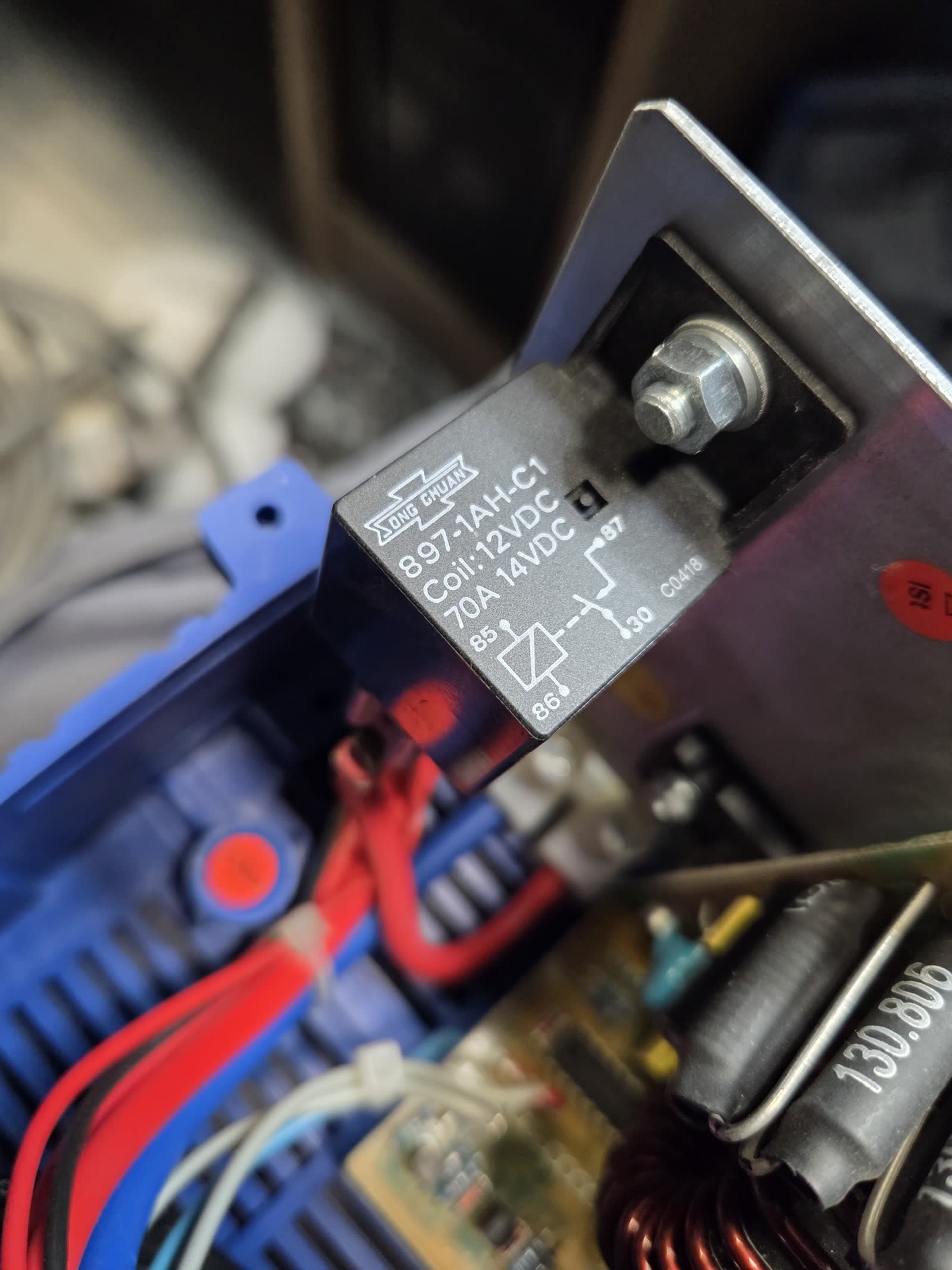
The Elektroblock has a power relay —typically a Song Chuan 897-1AH-C1, 12 V DC coil, 70 A contacts at 14 V— that activates on the alternator D+ signal and connects the starter battery with the auxiliary one so both charge while driving.
Classic symptom: the motorhome charges perfectly on 230 V mains but doesn’t charge when driving. You can drive two hours, arrive at the campsite and see the aux still at 12.2 V. Secondary symptom: when you turn on the ignition, you hear a continuous metallic buzz coming from the Elektroblock. That’s the relay with stuck contacts or a damaged coil.
To confirm it you need to remove the EBL from the vehicle, open it, and measure the relay coil with the multimeter in ohms: it should read between 70 and 90 Ω. If it reads zero (shorted coil) or infinite (open coil), the relay has to be replaced. These components are available at Mouser and RS for €15-20 but board-level replacement requires a decent soldering station, not a €10 iron.
Cause 4: the alternator D+ signal isn’t getting through
If the relay is healthy but doesn’t activate when driving, the problem is upstream of the Elektroblock: the alternator D+ signal isn’t arriving. This signal travels through a thin wire (usually yellow in the EBL’s Block 2 connector) and passes through a 2 A fuse in the engine compartment.
Diagnosis: with the engine running, probe the D+ terminal of the alternator with the multimeter. It should read 13.8–14.4 V. Then follow the wire to the Elektroblock and measure at the D+ pin of Block 2. If there’s voltage at the alternator but not at the EBL, the 2 A fuse has blown or the wire is cut.
This fault is not in the Elektroblock but in the vehicle wiring. It’s thoroughly documented in Schaudt’s official EBL 99 guide, and it’s the most reported fault on European forums like AC Pasión for the EBL 269 series.
I have a dedicated guide on the D+ signal and alternator if you want to go deeper.
Diagram: how charging flows inside a Schaudt Elektroblock
Before continuing, visualise what the EBL does when a charging source comes in. The actual flow for the EBL 99, 101, 208, 220 and 269 models is this:
Diagram of the auxiliary battery charging flow inside a Schaudt Elektroblock. The three sources (230 V mains, alternator D+ and solar panel) feed into the EBL which converts them into a regulated 13.8 V output to the auxiliary battery. If any of the internal blocks (charger, coupling relay, logic) fails, the battery won’t charge even if the source is fine.
Cause 5: the internal 230 V charger has failed
If plugging into mains doesn’t light the charge LED on the LT panel but starting the engine does, the 230 V charger is down. Inside the EBL that charger is a switched-mode power supply with toroidal transformer + rectifier bridge + filter capacitors + voltage regulator. Any of those four stages can be burnt.
The most visible symptom when opening the EBL is bulging electrolytic capacitors or brown traces at their base. They’re the first to go, especially on EBLs over 10 years old exposed to continuous vibration.
This fault is already workshop-level: it requires measuring the rectifier output with an oscilloscope and, if needed, replacing the entire capacitor bank. Indicative price between €120 and €180 for the repair. I have a dedicated guide on the 230 V charger failure if you want to dig in.
Cause 6: Block 2 connector melted
The Elektroblock’s white Block 2 connector carries several high-current wires (starter battery positive, D+, etc.). If there’s a loose contact over years, the pin heats up, the white plastic blackens and eventually melts. When that happens, the D+ signal doesn’t get through properly, the relay doesn’t close correctly and charging while driving is lost.
Visual diagnosis: unplug the connector and check whether the pins are black or the plastic is deformed. If so, the connector has to be replaced with a new one (they are standard JPT 6-way) and the female-side pins cleaned. Common repair, between €90 and €120.
Cause 7: the LT panel isn’t requesting charge
The living-area control panel —LT100, LT309, LT313, LT500 depending on motorhome model— is what tells the Elektroblock to activate the 12 V channels and enable charging. If the panel is off or has a firmware fault, the EBL receives 230 V mains but doesn’t convert it to aux charging.
Quick test: with the motorhome plugged into mains, press the 12 V button on the LT panel. The green LED should come on. If it doesn’t, the panel is unpowered or broken. Check the panel’s own fuse (a separate fuse, inside the LT panel itself), and if that’s fine, the LT panel is what needs repair. Typically €80-€100 for the repair.
Quick summary: decision table
| Observed symptom | Probable cause | Where to check |
|---|---|---|
| Plugged into 230 V doesn’t charge, but engine does | Internal 230 V charger | Inside the EBL (bench) |
| Engine doesn’t charge, but 230 V does | D+ signal or 70 A relay | Engine 2 A fuse + EBL relay |
| Doesn’t charge from either | Internal aux fuse or LT panel | T 3.15 AT fuse + panel |
| Continuous buzz when plugging in or starting | 897-1AH-C1 relay | Inside the EBL |
| Aux drains in 24 h even when “charging” | Sulphated battery | Outside the EBL |
| Charger LED off and connector black | Melted Block 2 | External EBL connector |
| Nothing responds from LT panel | Broken LT panel | Living area control unit |
When to send the Elektroblock for repair
Of the 7 causes, 4 are inside the Elektroblock (internal fuse, 70 A relay, 230 V charger, Block 2 connector) and 3 are in the vehicle or accessories (battery, engine D+, LT panel). If you’ve ruled out battery, D+ and panel and the problem persists, the fault is in the EBL itself and it’s time to repair it.
Bench diagnosis with professional equipment —lab power supply, electronic load, oscilloscope— resolves the ambiguity in 48 hours. In my workshop I run that diagnosis at no cost: you only pay if you accept the repair quote.
Official sources and references cited
- Schaudt GmbH — Elektroblock manufacturer · Original technical documentation for the EBL 99, 101, 208, 220, 269.
- Official EBL 99 manual (PDF, Spanish) · BL1-BL8 terminal diagram and fuse table.
- Official EBL 269 manual (PDF, English) · Charging diagram for the 260 series.
- AC Pasión — motorhome user forum · User-reported cases of the faults described here.
- Camperonline — Italian camper forum · Secondary reference for the parallelising relay fault.
- Song Chuan 897-1AH-C1 datasheet · 70 A relay specs for the one fitted in the EBL.
Related guides
- Elektroblock not charging on 220 V — what to check in the internal charger.
- Alternator D+ signal not reaching — 2 A fuse and engine bay wiring.
- 897-1AH-C1 70 A coupling relay — component replacement.
Read next
Other related faults.
Charging diagnosis
Elektroblock not charging when plugged into 220 V
You plug the motorhome into the campsite 230 V pedestal and the auxiliary battery keeps dropping. The green LED on the LT panel doesn't come on or flickers oddly. This guide covers what to check before sending the Elektroblock for repair, the most likely internal faults, and how much each one costs.
Read guide →
Signal diagnosis
Alternator D+ signal not reaching the Elektroblock
Your motorhome charges perfectly on 230 V mains but when driving on the road the auxiliary battery doesn't go up. The problem is almost always the alternator D+ signal not reaching the Elektroblock. Here's the 10-minute diagnosis.
Read guide →
Internal components
70 A coupling relay burnt inside the Elektroblock
The 70 A relay that connects the starter battery with the auxiliary one during driving charging is the component that fails most often in Schaudt Elektroblock units. It buzzes, sticks or stays open: three symptoms, one culprit. Here's when to replace it and how much it costs.
Read guide →
Next step
Time to repair? Free diagnosis by WhatsApp.
Send me the exact Elektroblock model and a photo of the LT panel. I'll confirm whether it's a common fault, the indicative price and how to pack it.
Message on WhatsApp